Article contents
In short
Prosthesis supports
4 implants
2 straight at the front, 2 at the sides angled up to 45°
Temporary prosthesis
1–3 days
fixed, after surgery
Permanent prosthesis
after 4–6 months
once the implants have healed in
All-on-4 package
from 146,500 UAH
one jaw, per the price list
Whether the method is right for you is decided by the dentist after an exam, a 3D scan (CT) and an assessment of your overall health.
Find out whether All-on-4 is right for you
Implant specialist consultation — 500 UAH: exam, CT scan review and a treatment plan
A removable denture has to come out at night. It can shift while you talk or eat, and an upper denture covers the palate, so food never tastes quite the same.
It may seem that getting teeth back on implants means a separate implant for every tooth, lots of surgeries and endless treatment.
But for a whole jaw, four implants are sometimes enough. The method is called All-on-4.
How All-on-4 works
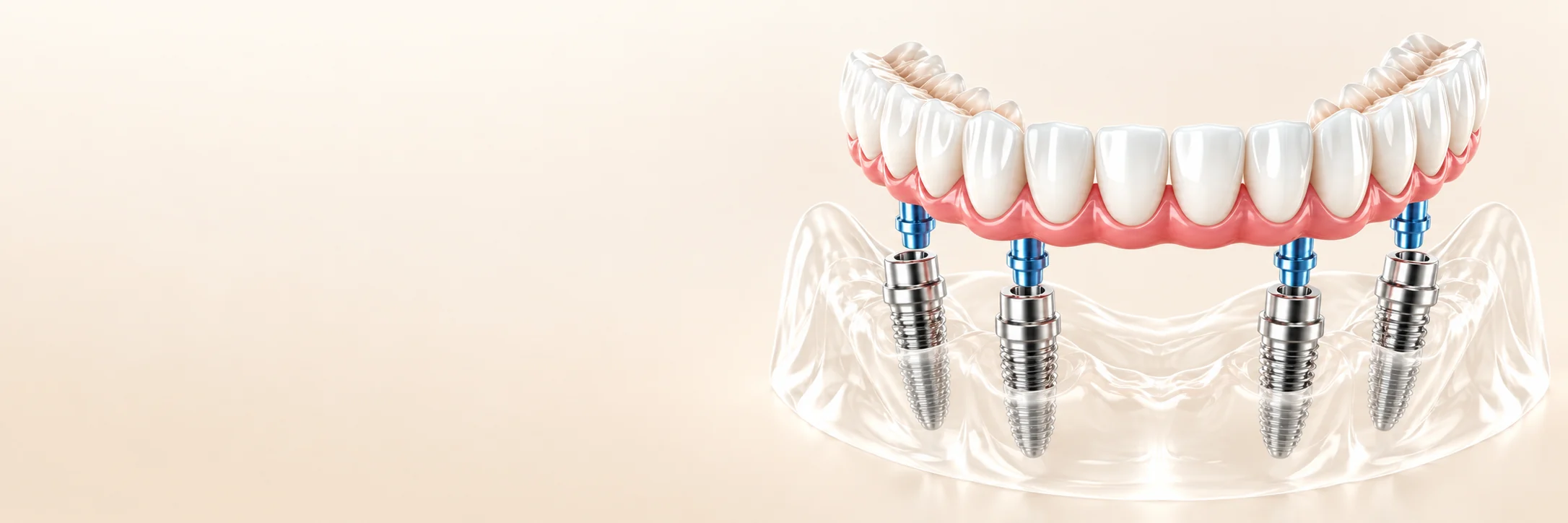
All-on-4 replaces all the teeth in one jaw with a single fixed prosthesis. It is held by four titanium implants — artificial roots placed in the bone.
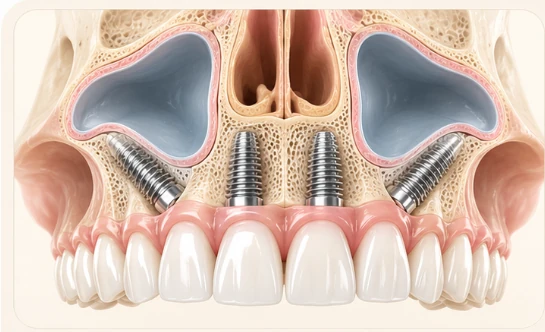
Two implants sit at the front, vertically. The other two are at the sides, angled up to 45°.
Upper jaw
Lower jaw
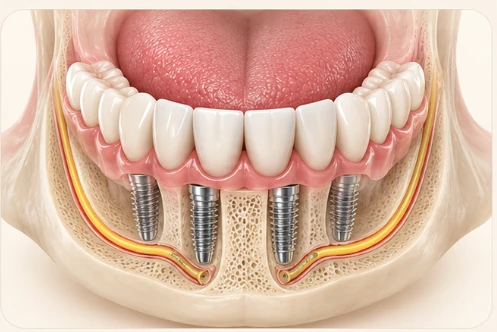
Why the angle? In the upper jaw, the maxillary sinuses sit above the back teeth; in the lower jaw, a nerve runs through. A tilted implant avoids these areas and rests on the parts where the bone is densest. This also increases its contact area with the bone.
Thanks to this, in most cases there is no need for lengthy bone grafting or a sinus lift. That matters for people who have been without teeth for a long time: bone loses density over the years.
Removable denture or All-on-4
Compare what you may be living with now and what an implant-supported prosthesis gives you.
A removable denture has one advantage — it costs less. The dentist shows you the difference in cost in your treatment plan.
Who All-on-4 is for
The method was designed for people who have lost all the teeth in a jaw, or whose teeth can no longer be saved. The dentist may suggest All-on-4 in these situations.
Sound familiar?
- you have no teeth at all in the upper or lower jaw;
- many of your teeth are badly damaged or loose because of periodontitis, and they cannot be saved;
- you have worn a removable acrylic denture for a long time and want a fixed one;
- you have little bone and would rather avoid bone grafting or a sinus lift;
- you want to get your smile and the ability to chew back as soon as possible.
So during the consultation, tell the dentist about all your chronic conditions, even the ones that seem unrelated to your teeth: they determine whether the surgery can go ahead.
Find out whether All-on-4 is right for you
Implant specialist consultation — 500 UAH: exam, CT scan review and a treatment plan
All-on-4 or All-on-6
During the consultation you may also hear about All-on-6. The principle is the same: a fixed full-arch prosthesis. The difference is the number of supports.
Six implants instead of four means two extra ones in the chewing zone. They spread the pressure across the jaw more evenly. The span between supports is shorter, and the load on each implant is lower.
All-on-6 is worth considering for people with a strong bite or soft bone. It is sometimes considered when All-on-4 cannot be placed.
You do not have to choose on your own. The dentist compares both options against your CT scan and explains which one suits you.
How treatment goes
- 01
Consultation and 3D scan
The dentist asks about your health and examines your gums and remaining teeth. On the CT scan, they assess bone volume and density and model where the implants will go. The scan itself takes 10–20 seconds. No special preparation is needed: just remove metal jewelry and your removable denture.
- 02
Plan and estimate
The dentist lays out the surgical and prosthetic stages with a price for each step. You know the full cost before treatment starts.
- 03
Surgery
The dentist extracts the teeth that cannot be saved and places the implants using a digital surgical guide. The procedure is done under local anesthesia or sedation (sleep dentistry).
- 04
Temporary teeth
After surgery, digital impressions are taken, and the dental lab makes the prosthesis from them. The temporary fixed prosthesis is attached to the implants on the day of surgery or within 1–3 days. You can smile and eat soft food with it.
- 05
Permanent prosthesis
While the implants heal in, you wear the temporary one — for 4 to 6 months. Then it is replaced with the permanent prosthesis: porcelain-fused-to-metal or zirconia.
How much All-on-4 costs
The price depends on two things: the implant system (Osstem, Neodent, MegaGen or Straumann) and the material of the permanent prosthesis. Below are the items from our price list as of October 2026.
Package prices are from the price list, per jaw. The permanent prosthesis and the full cost are set out by the dentist in the treatment plan.
What does the package include? The implants and the temporary fixed prosthesis. The permanent prosthesis is a separate stage; its cost is set out by the dentist in the treatment plan.
Who will treat you
Implants and prosthetics are placed by Eurozet oral surgeons and prosthodontists.

Vladyslav Yuriiovych
Chief dentist, oral surgeon, prosthodontist

Maksym Oleksandrovych
Oral surgeon, prosthodontist
You do not have to pay everything at once.
- Payment is split into two stages: implant placement and the permanent prosthesis.
- You can also spread the cost of treatment over monthly payments with PrivatBank installments.
- We also see patients covered by voluntary health insurance.
All-on-4 consultation
Exam, CT scan review and a treatment plan with the full cost
What to bring to the consultation
- A CT scan of your jaws, if it was taken no more than 3 months ago. If you do not have one, we can take it before your appointment.
- A list of your chronic conditions — the dentist will definitely ask about them.
- Your questions. For example: whether you need bone grafting, All-on-4 or All-on-6, which implant system the dentist recommends, how much the permanent prosthesis will cost.
Frequently asked questions
Can you really get teeth in one day?
Temporary ones — yes. The fixed temporary prosthesis is attached to the implants on the day of surgery or within 1–3 days. You can smile and eat soft food with it. The permanent prosthesis is placed later, once the implants have healed in.
Will I need bone grafting?
The side implants are placed at an angle to use denser bone. That is why, in most cases, there is no need for bone grafting or a sinus lift. Whether you need them is decided by the dentist from the CT scan.
Does implant placement hurt?
The implants are placed under local anesthesia or sedation (sleep dentistry). The dentist discusses which option suits you during the consultation.
Do I have to take the prosthesis out at night?
No. The All-on-4 prosthesis is fixed on the implants and does not come out. You wear it all the time, like your own teeth.
How do I care for a prosthesis on four implants?
Almost like your own teeth: brush every day with a toothbrush and toothpaste, rinse the space under the prosthesis with a water flosser, and come in for a professional cleaning twice a year.
Where do I start?
With an implant specialist consultation (500 UAH). The dentist examines your gums and teeth, reviews the 3D scan (CT, 1,200 UAH) and draws up a treatment plan with a price for each stage.