Article contents
In short
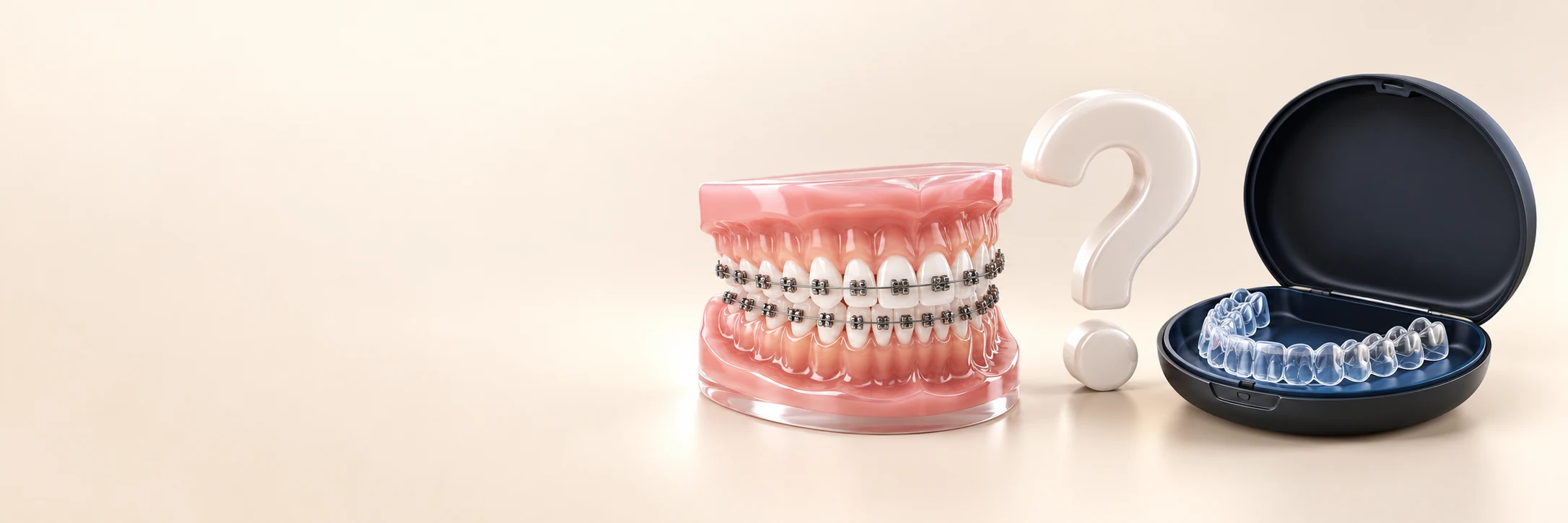
Braces
from 18,000 UAH
metal, one jaw, per the price list
Clear aligners
from 35,000 UAH
full course, one jaw, per the price list
Active treatment
12–24 months
depending on complexity; with aligners, 6 to 18
Aligners on your teeth
20–22 hours
a day, removed only to eat and brush
Which system is right for you is something the orthodontist decides after an exam, a photo series and a bite analysis.
Find out what suits you
Orthodontist consultation — 500 UAH: exam, photo series and a treatment plan
You have wanted straight teeth for a long time. But the moment you picture metal brackets on every tooth, the decision gets put off again: a work meeting, photos, smiling in conversation.
Then someone mentions clear trays that nobody notices. And you wonder: wait, that was an option all along?
It can be. But not always. Braces and clear aligners work differently, and each option has its price — not only in hryvnias, but in habits too. Here is an honest look, with no sales pitch.
How braces differ from clear aligners
Braces are a fixed appliance. A bracket is bonded to each tooth, and an orthodontic archwire is threaded through the brackets. At scheduled visits the orthodontist adjusts the wire, and it gradually moves the teeth.
Clear aligners are transparent removable trays made of a hypoallergenic medical polymer. They are made from a 3D model of your teeth. Each tray is designed for its own stage, and you switch to the next one yourself, following the orthodontist's schedule.
First, where aligners are more convenient.
Now, where braces are stronger.
The strength of braces is reliability in complex cases. The strength of aligners is looks and freedom, provided you do not forget to wear them.
Who should see an orthodontist
Straight teeth are not only about looks. A bad bite affects chewing load, the jaw joints and the enamel. It is worth booking a consultation if you notice anything on this list.
Sound familiar?
- your teeth are crooked or crowded, or there are gaps between them;
- your upper and lower teeth do not meet properly: a deep, open or crossbite;
- your jaw clicks or hurts when you open your mouth;
- your enamel is wearing down and your teeth often chip;
- you are planning veneers, crowns or implants and want to fix your bite first;
- your child is 6–7 years old and their teeth are starting to change.
Braces or clear aligners — let us decide together
Orthodontist consultation — 500 UAH: exam, photo series and a treatment plan
Types of braces
Braces differ in material and in how the wire is held in the bracket. Eurozet fits three types.
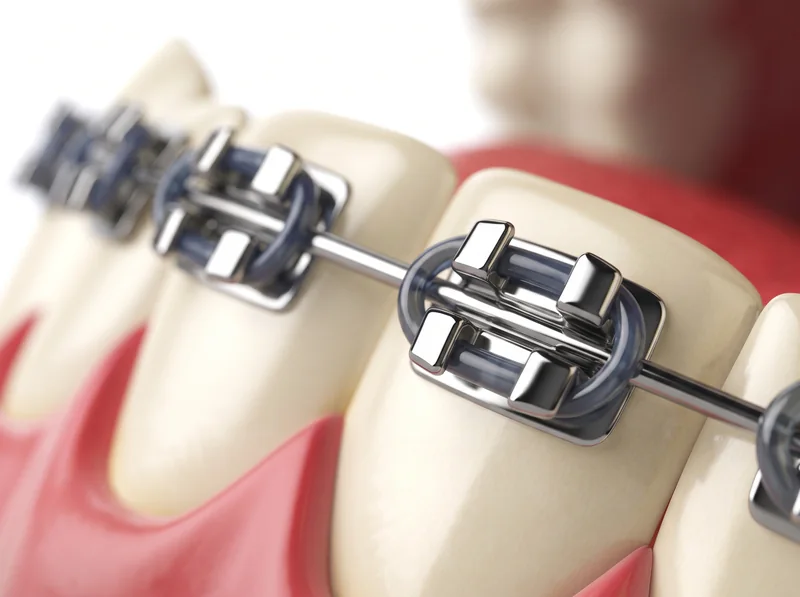
Metal
Ceramic
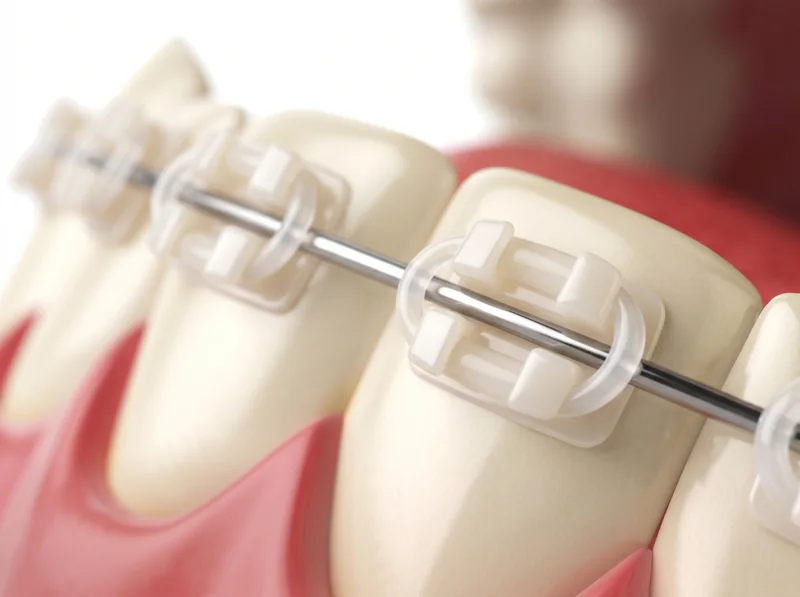
Metal braces are often chosen by teenagers and active patients: the brackets are sturdy and reliable. Ceramic ones suit those who want their braces to go unnoticed in conversation. Read more about each system on the "Metal braces", "Ceramic braces" and "Damon (Ormco) braces" pages.
Before fitting any braces, the orthodontist recommends a professional cleaning and treating any cavities. Caring for your teeth is harder with braces on, so it is best to get the enamel ready in advance. How a cleaning goes and what it costs is covered in our article "How often to get a professional teeth cleaning".
There are also lingual braces, which are bonded to the inside of the teeth. They are not on our price list.
How clear aligners work
Treatment with aligners starts with digital planning. Software models every stage of tooth movement, and you see the end result before the trays are even made.
- 01
3D diagnostics
An optical scan of your teeth and a virtual model of your jaws.
- 02
Virtual setup
The software calculates how each tooth will move, step by step.
- 03
Making the trays
Your personal set of aligners is printed on a 3D printer.
- 04
Wearing and switching
Every 10–14 days you switch to the next pair of trays yourself.
- 05
Checkups
Short checkups with the orthodontist once every 1.5–2 months.
Aligners have no brackets or wires that could irritate your mouth. You can play sports and speak in public with them. If needed, you can take a tray out for an important event and put it right back afterwards.
But the main rule is simple: an aligner only works while it is on your teeth. At least 20–22 hours a day.
Read more about aligner treatment on the "Clear aligners" page.
How long treatment takes and how often you visit
Active orthodontic treatment generally takes 12 to 24 months, depending on the complexity of the case.
The orthodontist gives you the exact timeline after diagnostics, and for aligners after the 3D setup.
Either way, there is an adjustment period: for a few days after braces are fitted or a new tray goes in, you may feel mild pressure (more on that in the questions below).
After treatment: retainer and tray
Once the braces come off or the aligner course is complete, the teeth try to drift back to where they were. The bone and gums around the roots need time to settle.
So the result has to be held in place. A thin fixed retainer is bonded to the inside of the six front teeth — it is invisible from the outside. A clear removable tray is worn at night; it holds the whole row, including the back teeth. Read more on the "Retainers and orthodontic trays" page.
What braces and clear aligners cost
The price depends on the system, and for aligners also on the number of trays in your set. Below are the items from our price list as of October 2026.
What goes into the estimate? The system, fitting, scheduled visits and the retention period. The orthodontist works out the full cost before treatment starts, and for aligners after the digital 3D plan.
Who will treat you
Braces and clear aligners are selected and managed by a Eurozet orthodontist.

Kateryna Serhiivna
Orthodontist
You do not have to pay everything at once.
- Payment can be split by stage: separately for fitting the braces, adjustments and removal. For aligners, by batch of trays.
- You can split the cost into monthly payments with the "Pay in installments" service from PrivatBank.
- We also see patients under voluntary health insurance programs.
Orthodontist consultation
Exam, photo series and a treatment plan with braces or clear aligners
What to bring to the consultation
- Recent X-rays, if you have them: a panoramic X-ray (OPG) or a lateral cephalometric X-ray — the image an orthodontist uses to assess the position of the jaws. If you have none, the orthodontist will order the imaging, which you can have done with us.
- Your preferences. What matters more to you: that the appliance is invisible, that you do not have to think about it every day, or that it fits your budget.
- Your questions. For example: braces or clear aligners in your case, how long treatment will take, how often you need to come in, what retention will cost.
Frequently asked questions
Which is better — braces or clear aligners?
Braces are more effective for serious bite problems and crowded teeth. Clear aligners are hard to notice and removable, but they suit mild and moderate cases. The orthodontist makes the final call after diagnostics and a bite analysis.
Can an adult have their bite corrected?
Yes, there is no age limit for orthodontic treatment. Braces and clear aligners move teeth in teenagers and adults alike.
At what age can a child get braces?
Usually once the baby teeth have been replaced by permanent ones, from around 11–12 years of age. A first preventive checkup with an orthodontist is recommended earlier — at 6–7 years.
Does getting used to braces or trays hurt?
For the first 3–7 days after braces are fitted or the wire is adjusted, you may feel slight pressure when chewing. With a new aligner tray, mild pressure usually lasts 1–2 days. The sensation passes quickly.
Do I need a retainer after clear aligners?
Yes. After braces and after aligners alike, the teeth try to drift back to where they were. A fixed retainer and a removable tray hold them in their new position.
How long does an orthodontist consultation take?
About 30–45 minutes. That is enough for an exam, a photo series (a set of photos of your face and smile) and a discussion of the options: braces or clear aligners, timelines and cost.