Article contents
In short
Adults
every 6 months
for most patients
Braces, implants, periodontitis
every 3–4 months
your dentist sets the schedule
Duration
60–90 minutes
ultrasonic scaling, Air Flow and polishing
Professional cleaning
from 2,800 to 4,000 UAH
per the price list; 2,000 UAH for children
How often you personally need a cleaning, your dentist will tell you after examining your teeth and gums.
Find out how often you need a cleaning
Dental hygienist consultation — 500 UAH: gum exam, home-care advice and a cleaning schedule
You brush twice a day and use floss or a water flosser. Yet at every checkup, the dentist still finds tartar.
Or your gums bleed now and then when you brush. It seems like a small thing that will pass on its own.
The problem is not that you brush poorly. A toothbrush simply cannot reach between the teeth and under the gumline. Plaque builds up there and gradually hardens, and once it does, you cannot remove it at home. That is what a professional cleaning is for.
Why you need a cleaning if you brush at home
Brushing at home removes fresh, soft plaque and food debris. But even a good toothbrush and a water flosser do not fully clean the spaces between the teeth and the area under the gumline.
The plaque left there mineralizes over time and turns into tartar. A toothbrush cannot remove tartar: a dentist does that with an ultrasonic scaler.
A professional cleaning does not replace brushing at home; it complements it. Without daily care, plaque quickly builds up again.
The opposite also happens: a person brushes diligently but has spent years using a toothbrush that is too hard or a highly abrasive toothpaste. This can wear down enamel and injure the gums. That is why, at the appointment, the hygienist selects care products for you and shows you the right brushing technique.
How often to get a professional cleaning
For most adults, every 6 months. That is usually enough to keep plaque from turning into tartar and causing gum inflammation.
More frequent cleanings are advised for people who find it harder to keep up with oral hygiene or who have a higher risk of inflammation.
Your dentist sets the exact schedule. During the consultation, the hygienist assesses your gums and the amount of buildup and explains how often you should come in.
Teeth cleaning for children
Children are advised to have a professional cleaning every 6 months. Preventive care can start as soon as the first teeth come in.
Air Flow is usually recommended from age 3–4. By then, a child can sit calmly in the chair and follow the dentist's simple requests.
For children, we use glycine- or erythritol-based powders. They are minimally abrasive and do not injure the gums. First, the dentist applies a safe solution that stains the plaque. This shows the dentist every problem area, and shows parents how well their child brushes at home.
At the end, the dentist picks a toothbrush and toothpaste and explains how to care for the teeth at home. Read more on the Teeth cleaning for children page.
Book a professional cleaning
Dental hygienist consultation — 500 UAH: gum exam, home-care advice and a cleaning schedule
What a professional cleaning involves
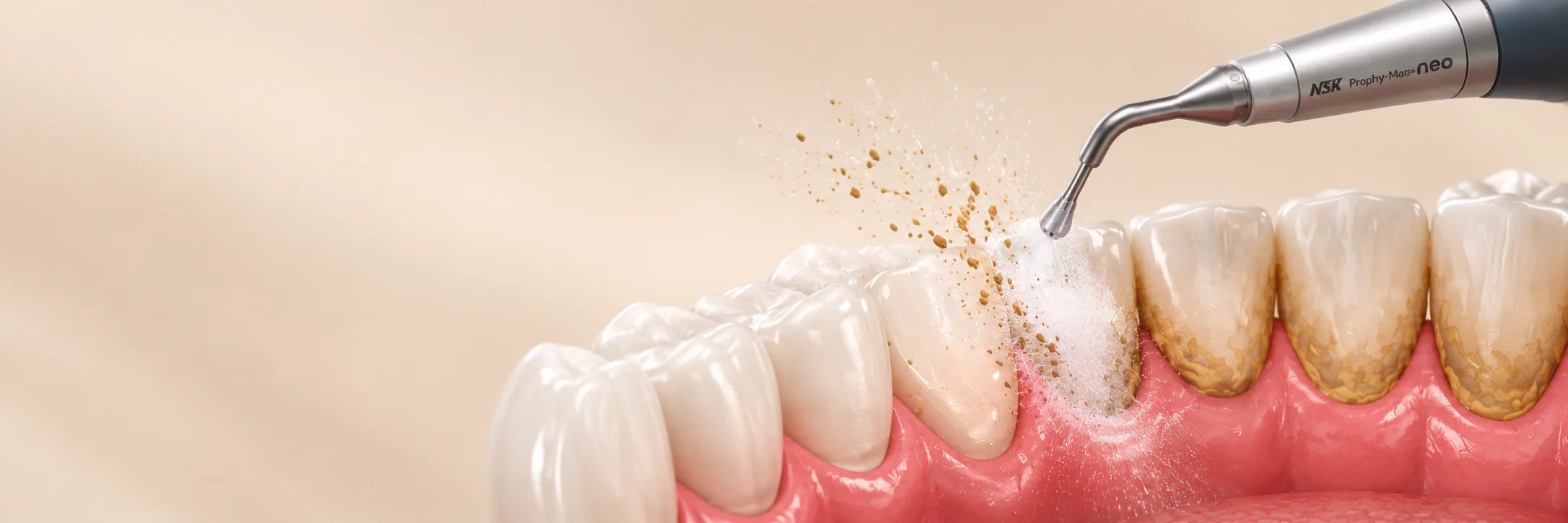
At Eurozet, cleanings are done with the NSK Varios Combi Pro unit. It combines ultrasonic scaling and Air Flow. All teeth on both jaws are cleaned.
- 01
Examination
The dentist assesses the gums and the amount of buildup on the teeth.
- 02
Ultrasonic scaling
An ultrasonic tip removes hard tartar above and below the gumline. The power is adjusted to how sensitive your teeth are.
- 03
Air Flow
A jet of water, air and fine powder removes soft plaque and stains from coffee, tea and smoking. The powder is chosen to suit the condition and sensitivity of your enamel. For veneers, crowns and implants there are gentle modes and erythritol- or glycine-based powders.
- 04
Polishing
The enamel is treated with special pastes to leave the tooth surface smooth.
- 05
Home-care advice
The dentist recommends a toothbrush, interdental brushes and toothpaste suited to your teeth and gums.
The whole procedure takes 60 to 90 minutes, depending on the condition of your teeth. Read more on the Varios Combi Pro teeth cleaning and Air Flow teeth cleaning pages.
After the cleaning, you can have a fluoride treatment: the enamel is coated with fluoride varnish or a remineralizing gel. Plaque-free enamel absorbs minerals well, so the two procedures are often combined. Read more on the Fluoride treatment page.
What happens if you put off a cleaning
Tartar pushes the gums back and makes them inflamed — this is gingivitis. The first sign is gums that bleed when you brush. See a dentist if you notice any of the following.
Sound familiar?
- your gums bleed, swell or feel tender when you brush;
- there is dark buildup on your teeth, or they feel rough;
- bad breath that does not go away after normal brushing;
- the necks of the teeth are exposed, or teeth have become loose.
If your gums already bleed, the dentist will tell you whether a cleaning is enough or whether you need gum treatment.
How much a professional cleaning costs
The dentist gives you the exact price at the exam, before the procedure starts. It depends on how much plaque and tartar is on your teeth. The price covers both jaws. Below are the items from our price list for October 2026.
In most cases, the hygienist consultation and the cleaning can be done in a single visit.
How to pay
- The dentist names the price at the exam, and it does not change during the procedure.
- You can split the cost into installments through the "Pay in installments" service from PrivatBank.
- We also see patients under voluntary health insurance plans.
Dental hygienist consultation
Gum exam, home-care advice and a cleaning schedule
What to bring to the consultation
- Information about any dental work in your mouth. If you have braces, veneers, crowns or implants, tell the hygienist: there are separate modes and powders for them.
- A word about sensitivity. If your teeth are sensitive, let the dentist know before the procedure — the ultrasonic power and powder flow will be adjusted.
- Your treatment plans. If you are planning whitening, braces or implants, mention it: a cleaning is often done as preparation.
- Your questions. For example: how often should I come in, which toothbrush and toothpaste should I choose, do I need a fluoride treatment.
Frequently asked questions
Does a professional cleaning hurt?
The ultrasonic power and powder flow are adjusted to how sensitive your teeth are. Patients with sensitive teeth may feel mild discomfort. If your teeth are sensitive, tell the dentist before the procedure.
What should I avoid right after a cleaning?
For the first 2–3 hours, avoid drinks that stain: coffee, tea, wine, juice. After a cleaning, the protective film on the teeth is temporarily gone, so the enamel picks up stains more easily.
Will my teeth be whiter after a cleaning?
Once the stained plaque from coffee, tea and smoking is removed, your teeth return to their natural shade. This is not whitening: the color of the enamel itself does not change.
Can I have a cleaning if I have veneers, crowns or implants?
Yes. The unit has gentle modes and erythritol- or glycine-based powders that are suitable for titanium abutments, ceramic veneers and restorations.
Can I have a cleaning during pregnancy?
Yes, a professional cleaning is recommended during pregnancy: hormonal changes raise the risk of gum inflammation. The second trimester is a convenient time for the procedure.
Do I need a cleaning before whitening, braces or implants?
Yes, a professional cleaning is done as preparation for whitening, braces, implants and cavity treatment. Your dentist will tell you whether you need one before your treatment. On choosing a system for straightening teeth, see the article Braces or clear aligners: which to choose; on implant prices, see How much dental implants cost.