
Article contents
In short
General dentist consultation
500 UAH
exam and a treatment plan with prices
Emergency care
2,000 UAH
seen without waiting in line
The exam takes
20–30 minutes
longer in complex cases
Open
9:00–21:00
every day
The cause of the pain is determined by a dentist after an exam and, if needed, an X-ray. This article is not a substitute for a consultation.
Toothache? Have a dentist look at it
General dentist consultation — 500 UAH: exam, X-ray if needed and a treatment plan with prices
Your tooth reacts to cold water. By evening the pain is throbbing, and you have to chew on the other side.
The first instinct is to wait it out: maybe it will pass on its own. Sometimes the pain really does subside. But that does not mean the problem is gone.
Pain is a signal that something is wrong with a tooth or the gums. Below: what causes it, when you should not wait, and what happens at the first appointment.
What can make a tooth hurt
Pain that feels the same can have different origins. Here are the situations people most often bring to the dentist.
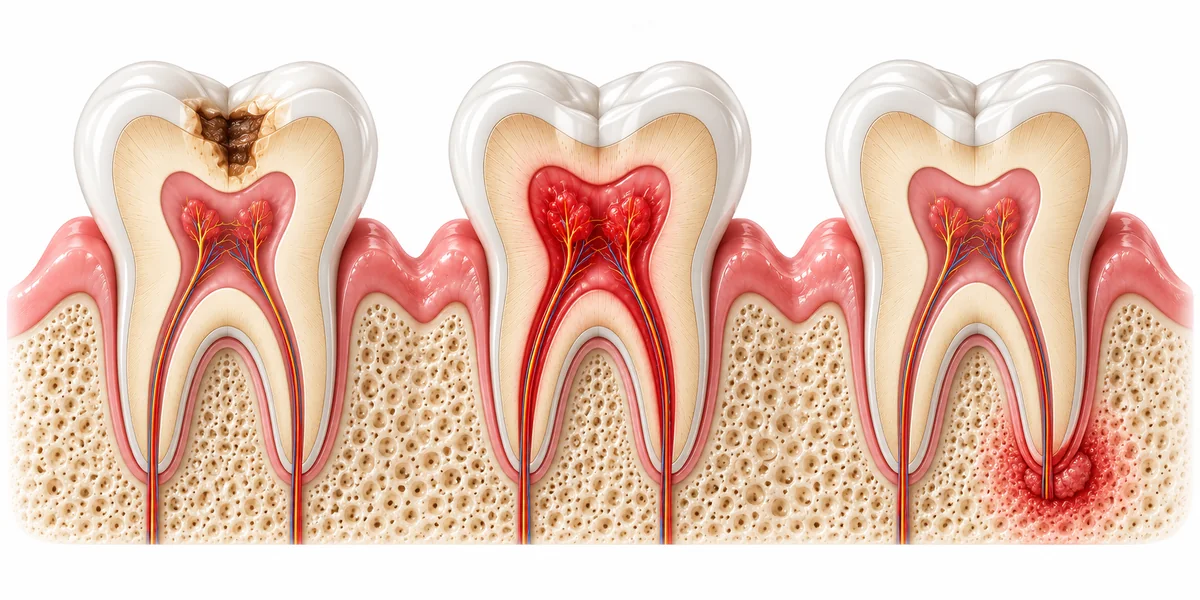
Tooth decay starts unnoticed, as a spot on the enamel. Without treatment it reaches the nerve, and the pain gets worse. Untreated pulpitis turns into inflammation around the root. How root canals are treated and why a microscope is used — in the article Root canal treatment under a microscope.
When you should not wait
Some signs mean you should see a dentist the same day rather than wait for a scheduled appointment.
Sound familiar?
- sharp pain that does not go away;
- swelling of the gums or cheek;
- a fever;
- pus or discharge.
An advanced infection can spread to neighboring teeth and the bone, and can even threaten your general health. The sooner you come in, the lower the risk of complications.
Wait it out or see a dentist
While a tooth hurts, it is easy to make a decision that costs more later. Here is what you should know.
In this article we do not recommend medications or doses. Before your visit, it is a good idea to gather any previous X-rays and recall which conditions you have and which medications you take.
Toothache? Have a dentist look at it
General dentist consultation — 500 UAH: exam, X-ray if needed and a treatment plan with prices
What the first visit involves
- 01
Conversation and exam
The dentist asks what is bothering you and when the pain started, then examines your teeth and gums and checks the gum pockets and your bite.
- 02
X-ray if needed
A periapical X-ray, a panoramic X-ray or a 3D scan (CT) shows what cannot be seen during the exam: the condition of the roots and bone, and decay between the teeth.
- 03
Treatment plan
You receive a plan listing the procedures, their order and the cost of each stage. Before treatment begins.
- 04
Answers to your questions
The dentist explains every item of the plan in plain language and helps you set priorities if your budget is limited.
- 05
Treatment
If the dentist has an opening in the schedule and you are ready, treatment can start the same day. It is done under local anesthesia.
How the tooth is treated if it is the cause
The method depends on how deep the damage goes.
For 1–3 days after root canal treatment, the tooth may be sensitive — this is a normal tissue response. Read more on the Cavity treatment and Root canal treatment pages.
If the gums are the cause, treatment starts with a professional cleaning, followed by the periodontist's plan. Read more on the Gum treatment page.
How much it costs
Prices from our price list for October 2026. The dentist gives you the exact cost after the exam and puts it in the plan before treatment begins.
X-rays, if needed, are paid for separately. Treatment is priced per tooth, so the total depends on the amount of work.
You do not have to pay everything at once.
- If your budget is limited, the dentist will help you set priorities in the treatment plan.
- You can split the cost of treatment into monthly installments through the "Pay in installments" service from PrivatBank.
- We also see patients under voluntary health insurance plans.
General dentist consultation
Exam, X-ray if needed and a treatment plan with prices
What to bring to the consultation
- Previous X-rays or records, if you were treated at another dental office.
- A list of chronic conditions, allergies and medications you take. The dentist will definitely ask about this: it affects the treatment plan.
- Your questions. For example: what hurts and why, can the tooth be saved, what to treat first, how much the whole plan will cost.
No special preparation is needed: just brush your teeth before the visit.
Frequently asked questions
Can I come in with a toothache without an appointment?
Yes. Emergency care means you are seen without waiting in line. If you come in at the end of the working day, the dentist stays late to see you. Call +38 (098) 661 10 99 before your visit, and the front desk will tell you which location to come to.
The pain is gone. Do I still need to see a dentist?
Yes. Inflammation inside the tooth is not always accompanied by pain, and decay does not stop on its own. Without treatment, the infection can spread to the jawbone and lead to the loss of the tooth.
Does it hurt to treat a tooth that already hurts?
Treatment is done under local anesthesia. The dentist chooses the anesthetic individually, including when the damage to the tooth is deep.
Can a tooth be treated in a single visit?
An uncomplicated cavity is treated in a single visit in most cases. Root canal treatment usually takes one or two visits. The dentist will tell you how many you need after the exam.
Can treatment start right after the consultation?
Yes, if the dentist has an opening in the schedule and you are ready. First you will receive a treatment plan with the cost.
How often should I come for a checkup if nothing hurts?
Every 6 months. Early-stage decay often has no obvious symptoms and is only found at a checkup, when treatment is simpler.