
Article contents
In short
Magnification under the microscope
20–30 times
plus bright lighting of the working area
Visit length
1–2 hours
depending on the number of canals and complexity
Number of visits
usually 1–2
confirmed after an exam and an X-ray
First-time treatment
from 5,500 UAH
1-canal tooth, per the price list
Whether you need a root canal, how many visits it will take and the final price are things the dentist will tell you after an exam and an X-ray.
Find out whether you need a root canal
General dentist consultation — 500 UAH: exam and a treatment plan with prices
Your tooth aches at night. After a cup of hot tea, the pain lingers for a long time. Or the gum next to the tooth is swollen and it hurts to bite down.
The words "you need a root canal" are scary. It sounds long, painful, and like the tooth will have to be pulled anyway.
In fact, root canal treatment is a way to keep your own tooth once the inflammation has reached the nerve. It is done under local anesthesia and, in most cases, takes one or two visits.
What happens inside the tooth
Inside every tooth is the pulp — soft tissue with nerves and blood vessels. It sits in the pulp chamber and in the narrow root canals.
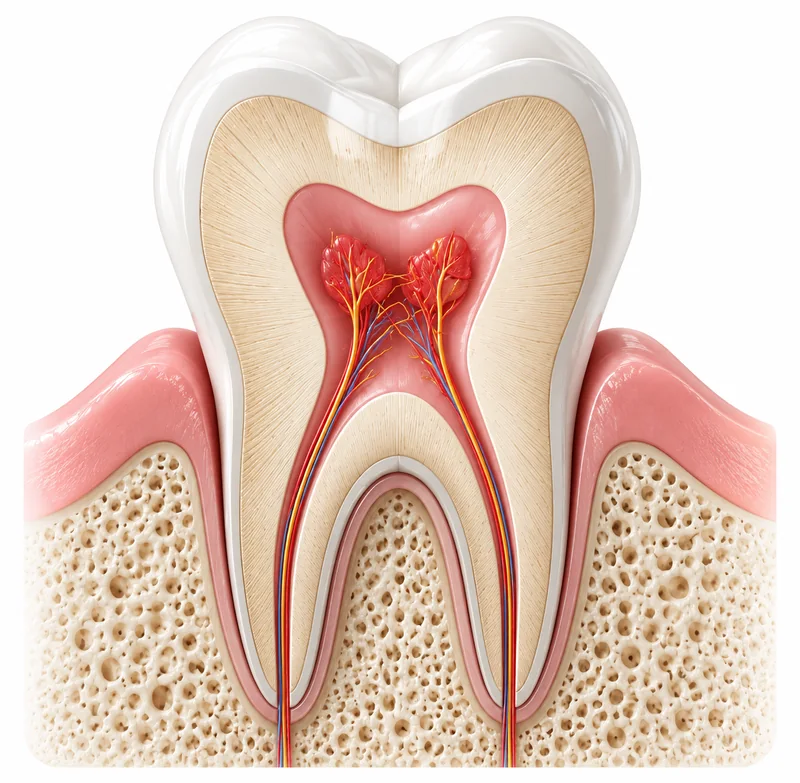
When decay or inflammation reaches the pulp, you get pulpitis. If the infection spreads further, into the tissues around the root, it becomes periodontitis.
A filling alone will not fix this. The dentist removes the inflamed pulp, cleans the canals and seals them tightly. That is root canal treatment, also called endodontics.
When you need a root canal
Without timely treatment you can lose the tooth, and the infection spreads to the tissues around the root. These are the signs worth seeing a dentist about.
Sound familiar?
- the tooth hurts sharply or throbs, often worse at night, when biting down or when touched;
- pain from hot food or drink lingers even after the trigger is gone, and sometimes only cold relieves it;
- the gum next to the tooth is swollen, red or sore, or a bump or a fistula has appeared;
- the crown of the tooth has darkened;
- the tooth feels "taller": it is the first to touch when you close your mouth and gets in the way of chewing.
Whether you need a root canal is something the dentist decides based on an exam and an X-ray. If your tooth hurts and the cause is not clear yet, start with our article "Toothache: what to do".
Why a microscope
Root canals are very narrow, and their shape is different in every person. Without magnification, the dentist relies mostly on touch and the X-ray.
A microscope magnifies the working area 20–30 times and lights it brightly. So every step is done under direct visual control.
If a canal or a branch is missed, the source of inflammation can stay inside the tooth. A microscope helps the dentist find and treat every canal, which lowers the risk of repeat inflammation and complications.
It matters most when:
- the canal anatomy is complex or curved;
- the canals have been treated before, but the inflammation or pain has come back;
- there is a broken instrument fragment, a post or old filling material in the canal;
- a hidden root crack or extra canals are suspected;
- you have been told to extract the tooth, but you want to try to keep it.
The microscope does not change what you feel. It only helps the dentist work more precisely. Read more on the "Treatment under a microscope" page.
Have your tooth checked by a dentist who works under a microscope
General dentist consultation — 500 UAH: exam and a treatment plan with prices
How the treatment goes
- 01
Diagnostics
Using a periapical X-ray or a CT scan, the dentist assesses the number and shape of the canals and the condition of the tissues around the root.
- 02
Anesthesia and isolation
The treatment is done under local anesthesia. A rubber dam isolates the tooth and protects it from saliva and infection.
- 03
Cleaning under the microscope
The dentist opens access to the canals, removes the inflamed pulp, then cleans and shapes every canal.
- 04
Filling
The cleaned canals are sealed with warm gutta-percha — a three-dimensional filling. Under magnification the dentist checks the quality of the work.
- 05
Restoring the tooth
The crown part of the tooth is rebuilt with a filling or a crown. This restores chewing and protects the tooth from chipping.
The visit takes 1 to 2 hours, depending on the number of canals and the complexity of the case. So it is best to agree on the time with the front desk in advance.
First-time or repeat treatment
Sometimes the canals have already been treated, and after a while the tooth starts hurting again. Then it needs repeat treatment — a retreatment.
Because of the extra work, retreatment costs more. Whether such a tooth can be saved, the dentist will explain after an X-ray or a CT scan.
A few more limitations are checked during the consultation. During an acute infection or a viral illness, the procedure is postponed until you are stable. Some blood disorders call for a doctor's consultation beforehand. Pregnancy is not a direct contraindication, but the timing of treatment should be agreed with your doctor.
How much root canal treatment under a microscope costs
The price depends on two things: how many canals the tooth has and whether it is being treated for the first time. The dentist cleans, shapes and fills each canal separately. Below are the items from our price list as of October 2026.
First-time root canal treatment with a microscope
Repeat treatment (retreatment) with a microscope
Consultation and diagnostics
How many canals does my tooth have? That shows on an X-ray or a CT scan. The dentist quotes the price before treatment begins. The full list is on the "Prices" page.
Who will treat you
An endodontist is a dentist who specializes specifically in root canal treatment.

Olha Yuriivna
Endodontist
You know the total in advance.
- The dentist draws up a treatment plan with the price after diagnostics, before any treatment starts.
- You can split the cost into monthly payments with the "Pay in installments" service from PrivatBank.
General dentist consultation
Exam, an X-ray if needed, and a treatment plan with prices
What to bring to the consultation
- Previous X-rays or records, if you were treated at another dental office before. If you have no X-ray, the dentist will take one at the visit.
- A list of chronic conditions, allergies and medications you take — this affects the treatment plan.
- Your questions. For example: how many canals the tooth has, whether it is a first-time or repeat treatment, a filling or a crown afterwards, how many visits it will take.
No special preparation is needed. Plan for about 20–30 minutes for the consultation.
Frequently asked questions
Does a root canal under a microscope hurt?
The treatment is done under local anesthesia, and the microscope does not change what you feel. Once the anesthesia wears off, there may be mild discomfort for 1–2 days — a normal tissue reaction.
How many visits does it take?
In most cases the treatment is completed in one or two visits. A visit takes 1 to 2 hours, depending on the number of canals and the complexity of the case.
Why treat the canals if the tooth does not hurt?
Inflammation inside a tooth does not always cause pain. Without treatment, the infection can spread to the jawbone and lead to losing the tooth.
Can a tooth be saved if the canals have already been treated?
In many cases, yes: that is what repeat treatment (retreatment) is for. The dentist assesses the canals and the tissues around the root on an X-ray or a CT scan and explains whether the tooth can be saved.
What happens to the tooth after a root canal?
After the canals are filled, the dentist rebuilds the crown part of the tooth with a filling or a crown. Which one is right for you depends on how much of the tooth is damaged.
Where do I start?
With a general dentist consultation (500 UAH). The dentist will examine the tooth, take a periapical X-ray if needed (200 UAH) and draw up a treatment plan with the price.